← All stories
An Interactive Visual Journey · Independent Editorial

What the
mountain keeps

Seventeen thousand kinds of apple became fifteen. Inside a mountain near the North Pole, a vault holds the frozen backups of the world's food — and once, when a war swallowed a genebank, it gave them back. This is how a backup for civilization works. You're going to run it.

An Undertold interactive · Independent editorial · · 8 min read + play
✦ move your cursor — wake the aurora Descend ↓
Chapter One

The extinction nobody photographed

A little over a century ago, North American orchards grew something like 17,000 named varieties of apple — russets and pippins and sheepnoses, sour keepers bred for a single county's frost. Today roughly 86% of them are gone, and about fifteen varieties account for the overwhelming majority of the apples sold in American stores.

Apples are just the variety we happened to write down. The same narrowing swept through wheat, rice, maize and beans across the twentieth century as farmers switched to a handful of high-yielding types. The UN's Food and Agriculture Organization has long estimated that around three-quarters of crop genetic diversity was lost between 1900 and 2000 — a figure repeated so often that its exact origin is now hard to trace, but whose direction no one disputes.

The plant scientist Cary Fowler called this loss "silent, rapid, inexorable." Silent because a seed variety doesn't go extinct with a bang — it just stops being planted, and one season nobody has it anymore. Drag the century forward below, and watch it happen.

FIELD 01 · A CENTURY OF VARIETIES● 1903 · 17,000 VARIETIES
190319502000
17,000varieties surviving
1903year
Illustrative simulation, not to scale. Each dot stands for many varieties; the apple figures anchor the curve. Genetic erosion is uneven across crops and regions.
Advertisement
AD SLOT · paste network embed here
Chapter Two

The safety net had holes

Diversity that leaves the field isn't necessarily gone. For a century, countries have kept genebanks — chilled warehouses of seed samples, each one a living archive of a crop's genetic past. There are now more than 1,700 of them worldwide, holding the seeds of some 7.4 million plant varieties between them.

Fowler, who first proposed an international crop-diversity treaty back in 1979, spent the 1980s and 90s discovering an uncomfortable truth: the archives themselves were failing. Underfunded genebanks were losing samples to broken freezers, humidity, war and neglect. The backup for the world's food was quietly deteriorating — and almost no one was backing up the backups.

A genebank is only as safe as its worst power cut. What the world needed was a copy of the copies, somewhere nothing could reach it.

A clue to where already existed. Since 1984, the Nordic Gene Bank had been stashing duplicate seeds inside an abandoned coal mine on the Arctic archipelago of Svalbard — using the permafrost as a free freezer. It worked well enough to prove the concept, and badly enough (hydrocarbon gases, only ‑3.5°C) to show a purpose-built vault was needed. In 2004, the Crop Trust was founded to endow the world's genebanks permanently; Norway agreed to carve a real vault into the rock.
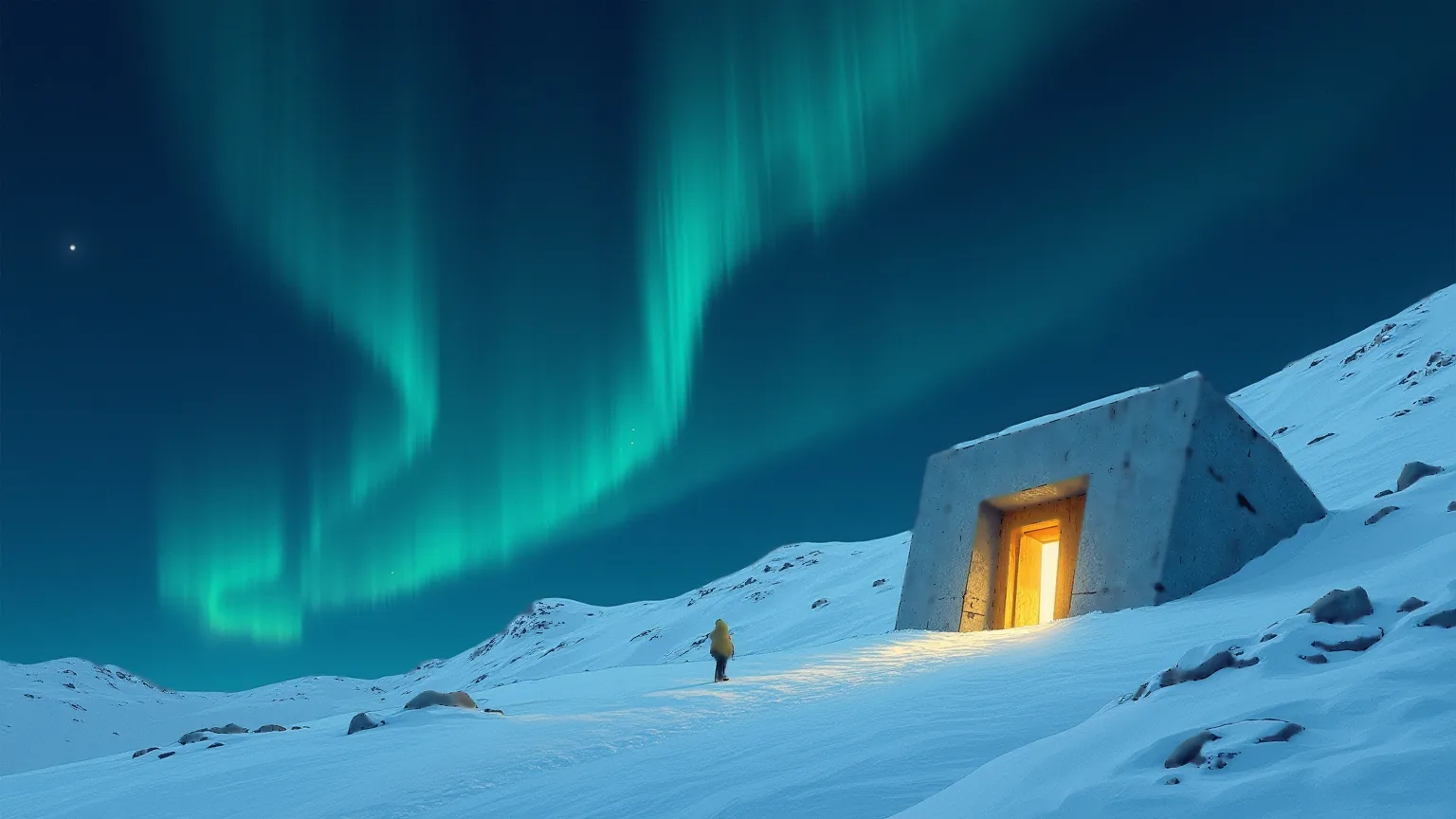

A 2D editorial banner split down the middle: on the left a coniferous forest burning under orange smoke, on the right a snowy, aurora-lit Arctic landscape, with a helicopter flying across the centre carrying a large sack of seeds slung on a cable beneath it.
The whole idea in one picture: crop diversity carried out of danger and into the safety of the cold. Symbolic illustration, AI-generated in Undertold's house style — a metaphor, not a depiction of a real event.
Chapter Three

Why a mountain at the top of the world

The Svalbard Global Seed Vault opened on 26 February 2008, bored roughly 130 metres into a sandstone mountain on Spitsbergen, at 78° north — closer to the North Pole than to the Arctic Circle. Norway paid for it outright, about 45 million kroner (US$8.8M at the time). At the opening, Prime Minister Jens Stoltenberg and the Nobel laureate Wangari Maathai laid the first seeds; more than 320,000 samples went in that day.

Four things make this spot close to ideal. It is remote and geologically stable, and high enough to stay dry as seas rise. It has real infrastructure — a town, an airport. Under the 1920 Svalbard Treaty it is Norwegian but demilitarized, neutral ground for a global commons. And above all, the mountain is cold: the surrounding permafrost sits near ‑3°C on its own, so if the freezers ever fail, physics keeps the seeds frozen while someone fixes them.

That last claim is the whole architecture of trust. So test it — cut the power and see how long the mountain holds the line.

SIM 01 · THERMAL FAILSAFE● COOLING ONLINE — ‑18°C
‑18.0°chamber temp
0days since failure
centuriesseed viability
Illustrative simulation, not to scale; warming accelerated for viewing. Real bedrock holds near ‑3°C; deposits are stored at ‑18°C, at which many seeds stay viable for decades to centuries.
Interactive · You're the operator

Fill the ark

Here is the thing that surprises people: the vault owns almost nothing inside it. Seeds arrive from genebanks worldwide, sealed in three-ply foil packets, boxed, and shelved at ‑18°C under a "black-box" rule — like a safe-deposit box, the depositor keeps ownership and holds the only key. Norway can't open Syria's boxes; the Crop Trust can't open Peru's.

Boxes are coming down the conveyor below, each one a real kind of depositor. Tap a box to seal and shelve it before it slides past. Watch the mountain fill — and keep an eye on the gold ICARDA box from Aleppo, Syria. You'll want to remember where it goes.

SIM 02 · SEED VAULT INTAKE● AWAITING DEPOSITS
0you've shelved
0slid past
1.40Maccessions in vault
→ black-box register — sealed accessions appear here
Illustrative simulation, not to scale. The vault holds ~1.4M accessions of a 4.5M capacity — still only about a third of the distinct samples held in the world's genebanks. Depositor labels are real examples.
Chapter Four

A vault that belongs to everyone and no one

In 2024 alone, 64,331 new safety duplicates arrived from 54 depositors, 21 of them sending seeds for the first time. Depositors range from vast international institutes to a single nation's heritage program. In February 2020 the Cherokee Nation became the first US tribe to deposit — nine varieties predating European arrival, including its sacred Cherokee White Eagle Corn.

"Cherokees cannot be Cherokees without their Cherokee plants." — Pat Gwin, Cherokee Nation

That line is the quiet argument of the whole place: crop diversity isn't only calories and yields, it's culture and memory and the option to grow something else when the climate changes the rules. The vault now guards roughly 1.4 million accessions — and still, that's the easy part. The hard part is proving a backup is worth building before you ever need it. Svalbard has needed it exactly once.

0sample capacity
0accessions stored
1 of 3genebank samples backed up
Advertisement
AD SLOT · paste network embed here
Interactive · The only withdrawal in its history

The rescue: Aleppo, and back

ICARDA — the International Center for Agricultural Research in the Dry Areas — kept one of the world's most important collections of drought-hardy wheat, barley and lentil at Tel Hadya, near Aleppo, Syria. Then the war came. The station was looted and damaged; the on-site collection was lost. But between 2008 and 2014, ICARDA had shipped 116,484 backup samples to Svalbard.

So in 2015 it did what no depositor had ever done: it asked for its seeds back. Run the loop yourself — withdraw the Aleppo backups from the mountain, regrow them in safe fields, and re-deposit the fresh harvest. This actually happened, in three withdrawals from 2015 to 2019.

SIM 03 · THE ICARDA LOOP● 2015 · GENEBANK UNREACHABLE
0samples withdrawn
0accessions regrown
0re-deposited
Illustrative simulation, not to scale. Figures follow the real operation: ~116,484 samples were backed up; regeneration took place in Lebanon and Morocco; 42,729+ accessions have since been re-deposited to Svalbard.

The seeds were flown to new stations in Terbol, Lebanon and Rabat, Morocco, planted, multiplied, and harvested. Then ICARDA began sending fresh duplicates back to Svalbard — more than 42,729 accessions re-deposited so far. The backup was used, and then rebuilt. It is, to date, the only time seeds have ever been withdrawn from the vault — and it worked exactly as designed.

Chapter Five

The honest ledger

A vault this good at symbolism attracts fair criticism, and the case for it is stronger for admitting them. Three are worth knowing.

Only a third of the picture

Roughly one in three of the distinct samples held in the world's genebanks has a backup in Svalbard. The vault is a safety net with real holes — and it is only ever as strong as the underfunded genebanks that fill it and, crucially, regenerate aging seeds when they lose viability. The freezer doesn't grow anything; people do.

Frozen isn't the same as alive

Groups like GRAIN argue that storing seeds in an Arctic freezer is no substitute for keeping them growing and evolving in farmers' fields — that ex-situ backup can quietly excuse the loss of living, in-situ diversity, and the farming cultures that sustain it. A seed in a box has stopped adapting to the world outside the box.

The climate irony is real

In October 2016 an unusually warm winter and heavy rain thawed permafrost and pushed meltwater about 15 metres into the entrance tunnel, where it froze. No seeds were ever at risk, but a vault built to outlast climate change had been touched by it — the Arctic is warming roughly four times the global rate. Norway responded with major waterproofing and drainage upgrades, completed in 2019.

None of this is a reason the vault shouldn't exist. It's a reason to be clear-eyed about what it is: a last line, not a first one — the copy you hope never to open.

Chapter Six

What it costs to keep a promise forever

Norway built the vault, but the seeds inside depend on the genebanks that feed it — and those need money that never runs out. The Crop Trust's answer is an endowment: a permanent fund whose interest pays to conserve crops "forever." The target is US$850 million; about $297 million has been raised. It supports conservation across more than 80 countries and 165 partner institutions.

The idea has quietly spread. Next door in another Svalbard mine, the Arctic World Archive now stores humanity's data on 500-year film — including, since 2020, a 21-terabyte snapshot of the world's open-source code from GitHub. Kew's Millennium Seed Bank backs up wild plants the same way. The permafrost, it turns out, makes a good cold backup for more than seeds.

0endowment target
0raised so far
0countries supported
If this story moved you

You just filled the vault
and ran the rescue.

The real one runs on an endowment that isn't full yet. This is independent editorial content — we are not affiliated with the Crop Trust and receive nothing from the link below. If you'd like to support the work described, you can give directly.