People decide, always
A rat never clears a mine or diagnoses a patient. Accredited deminers excavate every indication; laboratories confirm every flagged sample. The animal narrows the search — it is never allowed to close it.
 ✦ move your cursor — follow a scent
Dig ↓
✦ move your cursor — follow a scent
Dig ↓
A war can end and leave its arithmetic behind. Landmines do not expire with the treaty that scattered them; tens of millions remain in the ground across dozens of countries, seeded through farmland and footpaths and the edges of schoolyards, patient enough to wait out the children who will grow up walking over them. Clearing that ground the conventional way — a person on their knees, inch by inch, behind a metal detector — is slow and dangerous by design, and slower still because the detector cannot tell the difference between a mine and a bottle cap. It announces every buried scrap with the same urgent tone, and each one has to be checked by hand.
Tuberculosis keeps its secret differently. Once again the world's deadliest infectious disease, it slips past the ordinary defenses meant to catch it: the standard microscope test a clinic runs on a sputum sample misses a substantial share of genuine cases. The slide is read, the result comes back negative, the patient is sent home reassured — and the infection travels on, into a household, a bus, a workplace. The two dangers share almost nothing except the trait that matters most. Both are hidden, and for both, the cost of the search is measured in the time it takes to find them.
APOPO's wager was that a good enough nose could find what our instruments overlook — and that the nose in question belonged to a rat.
The idea arrived, as good ideas often do, from an odd angle. In the mid-1990s a Belgian product-design graduate named Bart Weetjens was turning over the problem of landmines — specifically, how to clear them without the expense that made clearance unaffordable in the places that needed it most. He had kept rats as a boy and never quite lost his regard for them: intelligent, trainable, cheap to keep, and native to almost everywhere the mines were. When he came across research on using rodents as scent detectors, the pieces fit.
He took the notion to a rodent specialist at the University of Antwerp, who pointed him toward the giant African pouched rat — large, long-lived, and equipped with a remarkable nose. In 1997, Weetjens and his former schoolmate Christophe Cox founded APOPO to test whether the animal could be taught the work. The training later settled in Morogoro, Tanzania, where the rats learned to fix on a single smell and to ask, in their way, for a reward when they found it. The organization calls them HeroRATs. Their gift is the nose — but their usefulness lies in what the nose is trained to ignore.
Both bars are clearing the same 200 m² plot — roughly the footprint of a tennis court. A HeroRAT finishes it in about thirty minutes. A person sweeping that identical ground with a metal detector can spend up to four days on it, because the detector cannot distinguish a mine from a buried nail, and every last signal has to be knelt over and checked by hand. The rat sets all of that noise aside; it answers only to the smell of explosive. The gap you are watching open is the difference between searching for something and searching for everything.
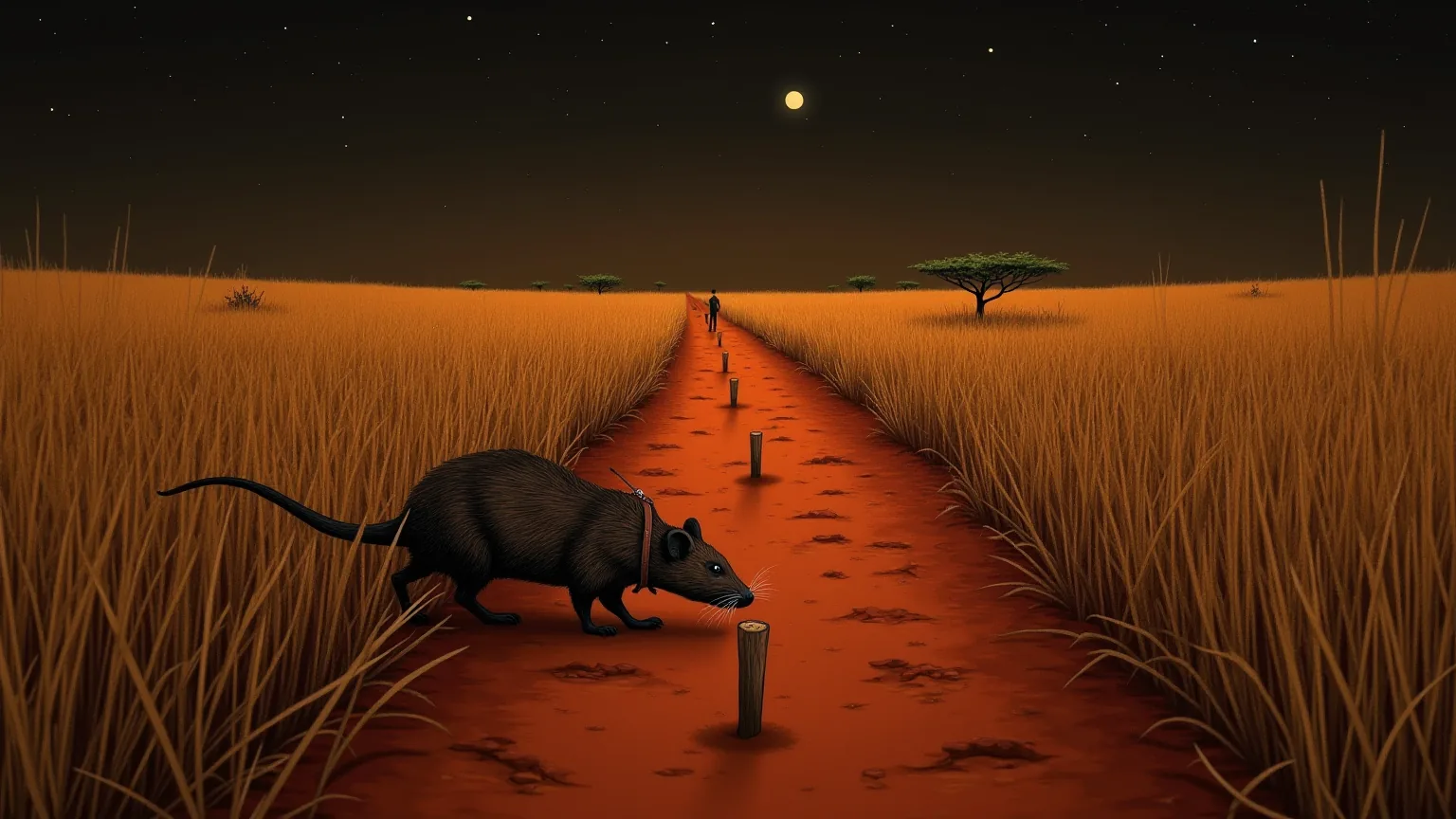
Real clearance is patient, gridded, unhurried work. The ground is divided into narrow lanes, and a rat is walked along a line strung between two handlers, back and forth, on a harness. When it catches the scent of explosive it stops and scratches at the earth — and then, in the moment that defines the whole method, it is walked away. A human deminer takes it from there.
Press play and let the rat run the lane. It sweeps back and forth on its own, the way it would on the harness — pausing to scratch wherever it catches the scent, so a deminer knows exactly where to dig.
Summary of this interactive: a rat walks a gridded search lane back and forth on a harness, pausing to scratch wherever it catches the scent of explosive. Each pause is an indication, not a clearance — the rat is walked away and an accredited human deminer excavates and confirms every one. The readouts below report square metres swept and indications marked.
A metal detector cannot help itself; noticing metal is the whole of what it does. A rat trained on scent notices only the chemistry it has been rewarded for, and lets the rest of the world go by. That single distinction — searching for the target instead of for everything — is what collapses four days of work into thirty minutes. The training that produces it is unglamorous and entirely gentle: the rat smells the target compound, hears a click, receives a treat, and repeats the sequence until the search becomes the most rewarding game it knows. There is no punishment anywhere in the method, only the patient accumulation of a habit.
The standards around that habit are strict. Before a mine-detection rat is allowed anywhere near live explosives, it must pass a blind accreditation test administered by outside authorities rather than by APOPO itself. And the slow arithmetic of all that training has added up. By the end of 2023, the organization reports, its programs had helped release a hundred million square metres of land — clearing more than thirty-one thousand landmines and ninety thousand other explosive remnants of war, and handing safe ground back to more than two million people.
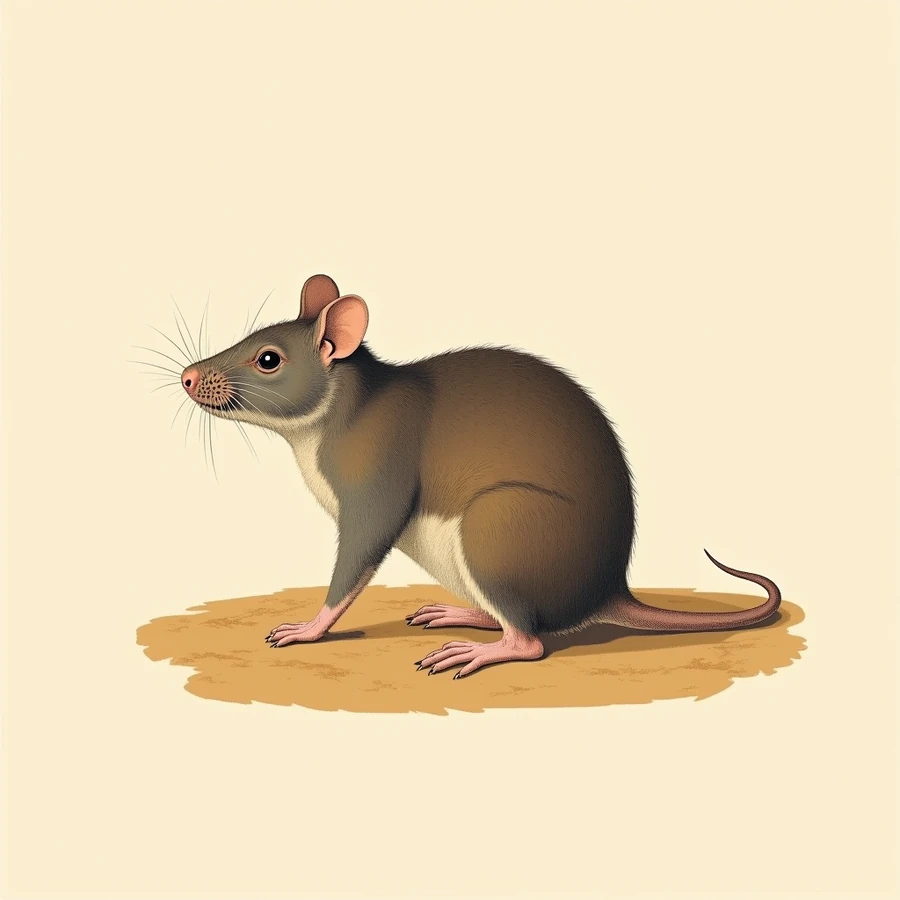
The same nose works indoors, under fluorescent light. APOPO partners with clinics that screen for tuberculosis, and the samples those clinics have already called negative are heat-treated to render them safe, then lined up for a rat that runs the row and pauses over any that carry the disease's particular smell. A pause is not a diagnosis. It is closer to a nomination — a request that someone look again. Every sample the rat flags is re-tested by the laboratory using standard methods, and only a result the lab confirms travels back to the clinic to bring the patient in.
Send the rat down the line. Watch which "clear" samples it stops on — and, just as important, what the lab does with them next.
Summary of this interactive: ten sputum samples a clinic has already recorded as negative are heat-treated and lined up. The rat runs the row and pauses over any carrying the smell of tuberculosis. A pause is a nomination for a second look, not a diagnosis: every flagged sample goes back to the laboratory, and only a lab-confirmed result reaches the patient. The readouts below show how many the rat flagged and how many the lab confirmed.
The totals are difficult to wave away. Through the end of 2022, APOPO reports that its tuberculosis rats had re-screened more than eight hundred and seventy thousand sputum samples and surfaced over twenty-six thousand people whose infections their clinics had initially missed — patients who would otherwise have walked home believing themselves well, carrying the disease into the ordinary places people gather. Across the partner clinics, the program reports lifting the local detection rate by roughly forty percent.
Yet every one of those cases still had to clear the laboratory before it was counted as real. That is the quiet discipline at the center of the whole enterprise: the rat was never asked to be right on its own. Its job was to hand the lab a shorter, smarter list — to turn an impossible pile of second looks into a manageable few.
The honest version of this story keeps the people firmly in the frame. Detection animals are a screening layer, never a verdict, and even the strongest evidence for the tuberculosis work arrives with caveats that are worth sitting with before you let yourself be won over completely.
A rat never clears a mine or diagnoses a patient. Accredited deminers excavate every indication; laboratories confirm every flagged sample. The animal narrows the search — it is never allowed to close it.
A 2021 meta-analysis found good pooled accuracy for TB rats but noted that nearly all the underlying studies came from APOPO's own researchers, with wide variation between them. Independent replication remains thin.
Mine-detection rats need workable terrain and cooperative weather, and they remain one instrument inside larger accredited operations. Where they don't fit, dogs, machines, and manual teams still carry the load.
This is independent editorial. We are not affiliated with APOPO, and we receive nothing from the link below. If the work described here — the animals, and the people who kneel in the dirt and stand at the lab bench beside them — feels worth sustaining, you can give to it directly.
Support APOPO directly100% of donations go to APOPO. This site is supported by advertising only.